


"Why Do They Hate Us?"Practice What You Preach...There are people all around the globe who hate America. Although it has always been that way, anti-Americanism is increasingly gaining strength. We are often told foreigners hate us because they are jealous of our privileges, our freedoms, or our wealth. In reality, they disagree and despise the impact the policies of the U.S. has—not only on their lives—but on the entire world. History is replete with dozens of examples of where American covert activities and overt foreign policy has thoroughly and callously undermined the very values that the American government so publicly and loudly proclaims. Americans tend not to see this, because they are unconcerned with the rest of the world and tend to uncritically trust their government to do the right thing. Seldom do they see the behavior of their government abroad as the rest of the world sees it. But the victims, millions of them around the world, do see it, and see it in their lives every day, and they know who is ultimately responsible. Blowback
Manuel Noriega, Saddam Hussein, Timothy McVeigh and Osama bin Laden are were all nurtured for many years by the CIA, the U.S. military or military intelligence and tragically serve as reminders of misguided U.S. government activities that ended up as blowback. Military Interventions
This is not the way most of us think of U.S. foreign policy. As Chalmers Johnson points out: “We Americans deeply believe that our role in the world is virtuous—that our actions are almost invariably for the good of others as well as ourselves. Even when our actions have led to disaster, we assume that the motives behind them were honorable.” But, Johnson now believes, “the evidence is building up that in the decade following the end of the Cold War, the United States has largely abandoned a reliance on diplomacy, economic aid, international law, and multilateral institutions in carrying out its foreign policies and resorted much of the time to bluster, military force, and financial manipulation.” Our Dangerous Swagger We do not think of these overseas deployments as a form of empire. In fact, most Americans do not give them any thought at all until something truly shocking—such as the treatment of prisoners at Abu Ghraib or Guantánamo Bay—brings them to our attention. But the people living next door to these bases and dealing with the swaggering soldiers who brawl and sometimes rape their women (see Okinawa details) certainly think of them as imperial enclaves, just as the peoples of ancient Iberia or nineteenth-century India knew that they were victims of foreign colonization. Instead of behaving in a professional manner our military (1) invaded Iraq with far too small a force; (2) tolerated an orgy of looting and lawlessness throughout the country; and (3) disobeyed orders and ignored international obligations (see next paragraph). These actions have incessantly fanned the flames of discontent, sowing the seeds for a potential bloody civil war. The Battle for Baghdad - Oil for the new
Mongols There have been many dispiriting sights on TV since the Iraqi war began—the pictures from Abu Ghraib; seeing Fallujah laid waste; American soldiers kicking down the doors of private homes and pointing assault rifles at women and children. But few have reverberated historically like the looting of Baghdad's museum—or been forgotten more quickly in this country. As the evening news documented, the American forces made no effort to prevent the looting of the great cultural institutions of Iraq, its soldiers simply stood by, watching vandals enter and torch the buildings. The destruction and rampant looting of the Baghdad National Museum (April 11 and 12, 2003) along with the burning (April 14, 2003) of the National Library and Archives as well as the Library of Korans at the Ministry of Religious Endowments were, according to Paul Zimansky, a Boston University archaeologist, "the greatest cultural disaster of the last 500 years." Eleanor Robson of All Souls College, Oxford, said, "You'd have to go back centuries, to the Mongol invasion of Baghdad in 1258, to find looting on this scale." During the battle for Baghdad, the U.S. military was perfectly willing to dispatch some 2,000 troops to secure northern Iraq's oilfields yet Secretary Rumsfeld compared the looting of the Baghdad National Museum to the aftermath of a soccer game and shrugged it off with the comment that “Stuff happens! Freedom's untidy... Free people are free to make mistakes and commit crimes and do bad things.” At the 6,000-year-old Sumerian city of Ur on a massive stepped temple-tower (built in the period 2112 - 2095 B.C. and restored by Nebuchadnezzar II in the sixth century B.C.), the Marines spray-painted their motto, "Semper Fi" (semper fidelis, always faithful) onto its walls. Shortly thereafter, the military then made the monument "off limits" to everyone in order to disguise the desecration that had occurred there, including the looting by U.S. soldiers of clay bricks used in the construction of the ancient buildings. Sanitized Euphemisms
The media allowed themselves to be manipulated into using sanitized expressions like "collateral damage," "regime change," "illegal combatants," and "preventive war" as if these somehow explained and justified what the Pentagon was doing. At the same time, the government was making strenuous efforts to prevent the new International Criminal Court from ever having the option of considering war crimes charges against American officials. |
||||||
 The term "blowback,"
(
The term "blowback,"
( 
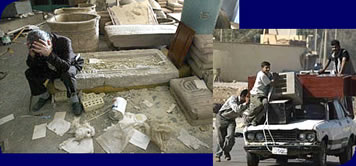 A
March 25, 2003 press release from the Marines described securing
Iraq's oil producing regions as "one of the first objectives
of Operation Iraqi Freedom," and Secretary of Defense Donald
Rumsfeld acknowledged at press conferences that securing
oil wells was a top priority for the military. As the resistance
in Baghdad fell; although the Ministry of Oil was protected--callously
and seemingly without an ounce of remorse--the National Museum
was left to the looters.
A
March 25, 2003 press release from the Marines described securing
Iraq's oil producing regions as "one of the first objectives
of Operation Iraqi Freedom," and Secretary of Defense Donald
Rumsfeld acknowledged at press conferences that securing
oil wells was a top priority for the military. As the resistance
in Baghdad fell; although the Ministry of Oil was protected--callously
and seemingly without an ounce of remorse--the National Museum
was left to the looters.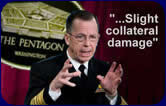
 Print
Version
Print
Version